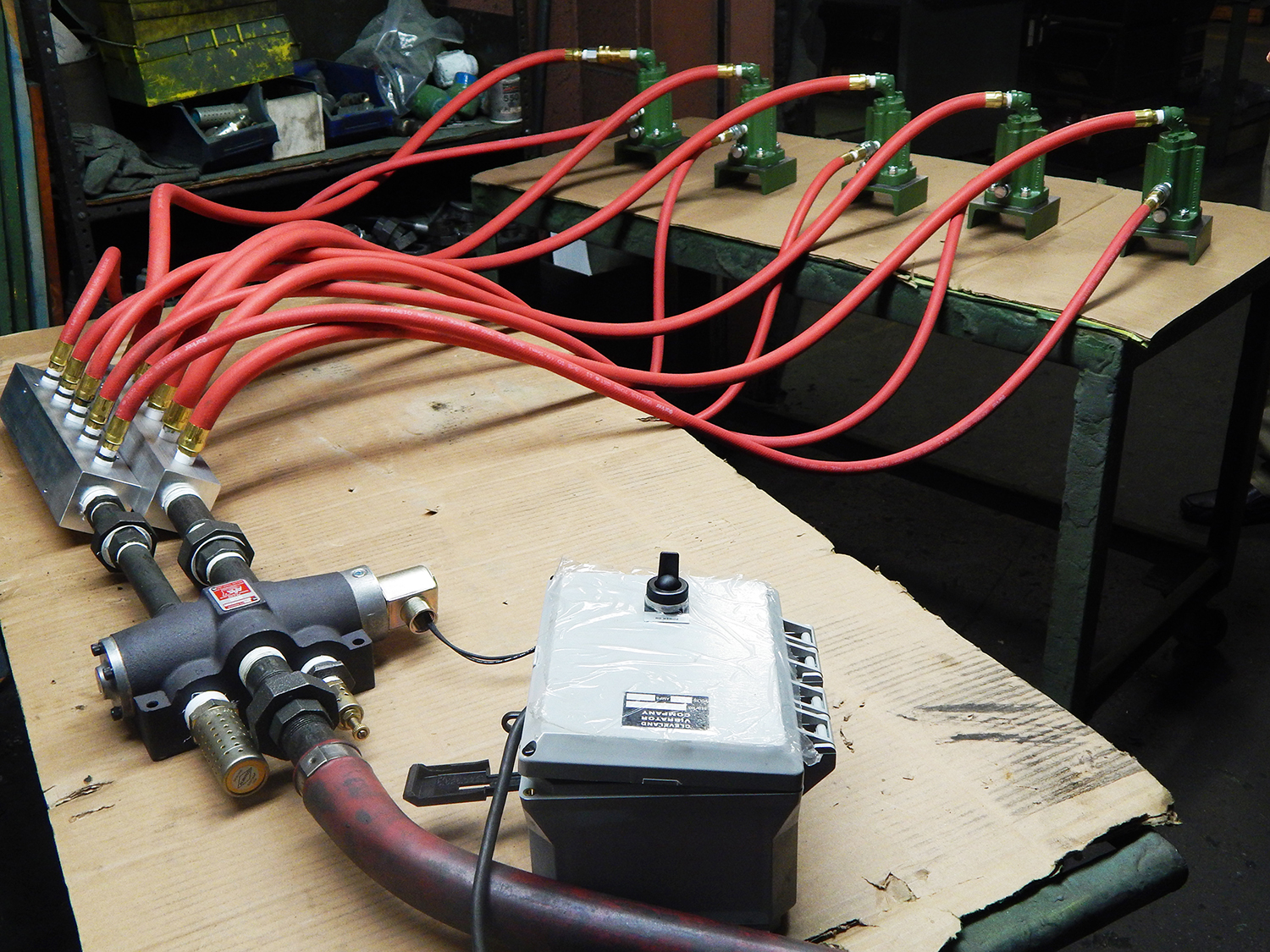
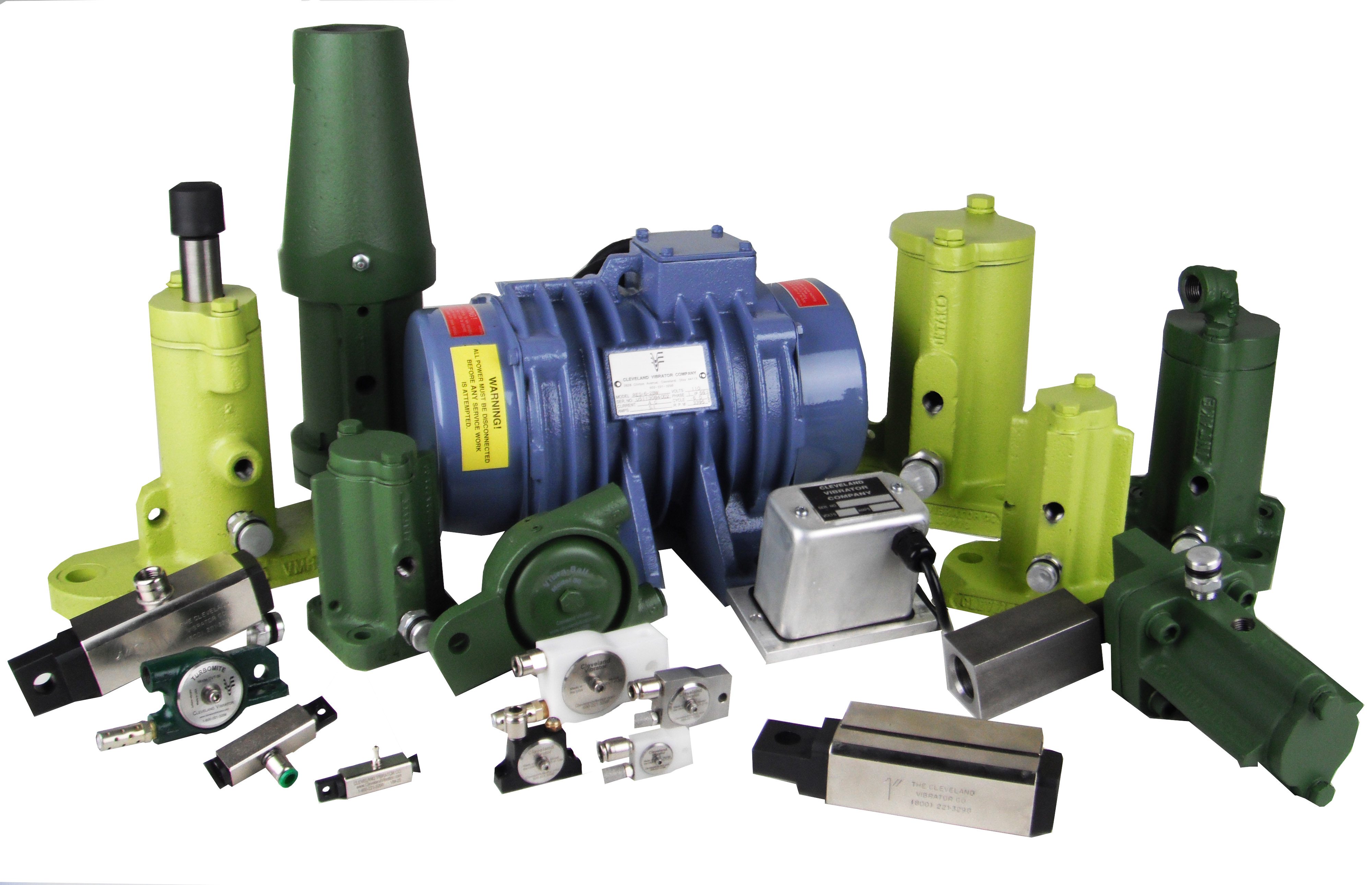
I have said for years to my “better half”, you can never have enough “toys” especially as it pertains to tools and for sure in my case golf clubs. This can be said about a recent spray dryer hopper application. We normally mount one industrial vibrator to the side of a hopper or bin and sometimes two by placing the second vibrator 180 degrees apart from the first vibrator installation area. In rare cases, we will actually mount three vibrators 120 degrees apart. The spray dryer customer wanted to mount five of our 1125 SI Single Impact Air Knockers on one hopper to dislodge sticky material. Not only did they want to mount five vibrators, but they also wanted them to impact at the same time. So, the folks of Cleveland Vibrator got creative. Read More…
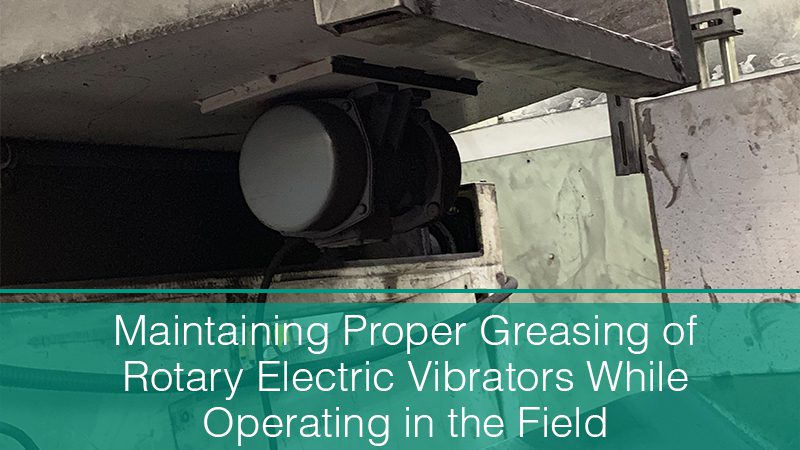
Being in this industry for a long time, we can relate to the uncertainty surrounding when you should grease your Rotary Electric Vibrators and how much grease you should apply. We offer an easy-to-follow installation and operation manual to our customers that discusses the specifics for each vibrator.
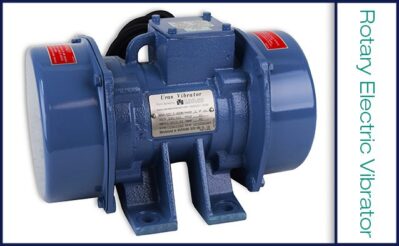
A section of the manual addresses proper greasing of the bearings, including when to apply the grease and how much to apply. The manual explains a ratio that takes into account the intervals vs. the actual running hours. This ratio will help determine when greasing the unit is necessary. There is, in my opinion, a “grey” area. Our Rotary Electric VIbrators need a certain amount of grease (measured in grams) to be adequately lubricated.
How do you determine the amount of grease for your rotary electric vibrator when the amount of grease per pump of the grease gun handle is unknown?
One method we’ve heard over the years is if the bearings begin to make noise, simply give each bearing five or six pumps from the grease gun and let it run for a few minutes. If this quiets the bearings after a few minutes, then you’re good to go. If not, repeat the process.
Is this recommended by The Cleveland Vibrator Company to properly lubricate the bearing? Well, no, it’s not. However, this type of greasing exists, and some swear by it. There is an old saying, “if it ain’t broke, don’t fix it,” and if it works for some folks, then we would not try to change the way they do it. However, for a straightforward approach, we looked at the amount of grease generated by one pump of a standard manual lever-operated grease gun and headed to our testing lab.
We took our standard grease gun, which uses a 14.8 ounce/420-gram cartridge, weighed out how much grease was in one pump, and then converted it to grams. We checked what the standard amount of grease would be for a grease gun of this size. The amount varied from 1.25 grams per pump to 2.25 grams, depending on how efficient your grease gun was.
A quick note that the grease we use is PREMALUBE Heavy-duty NLG1 #2 Multi-Purpose Grease H2, the manufacturer is Lubemaster. If you are working with a pneumatic vibrator, we have a blog that outlines what lubrications should NOT be used for your unit, click here to check that out.
We took many circumstances into account when performing our testing of the grease gun in our lab, such as:
The greasing procedure is not perfect
The effect of different operators
Condition of the grease fittings
Environmental temperature
The condition of the grease gun
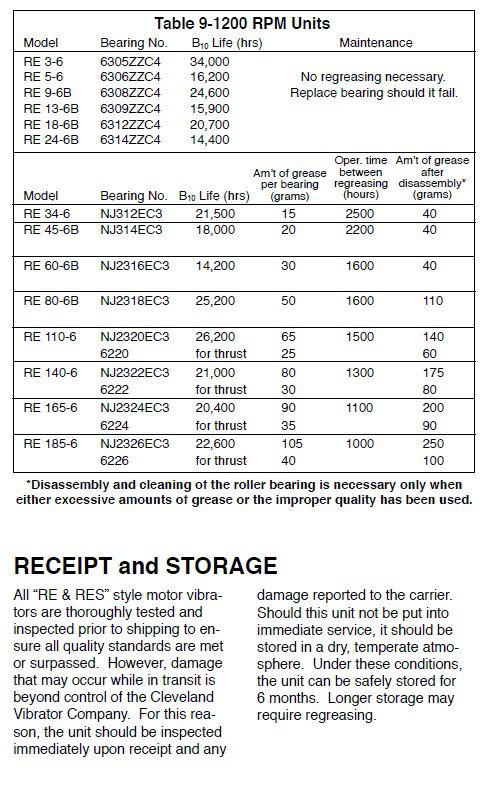
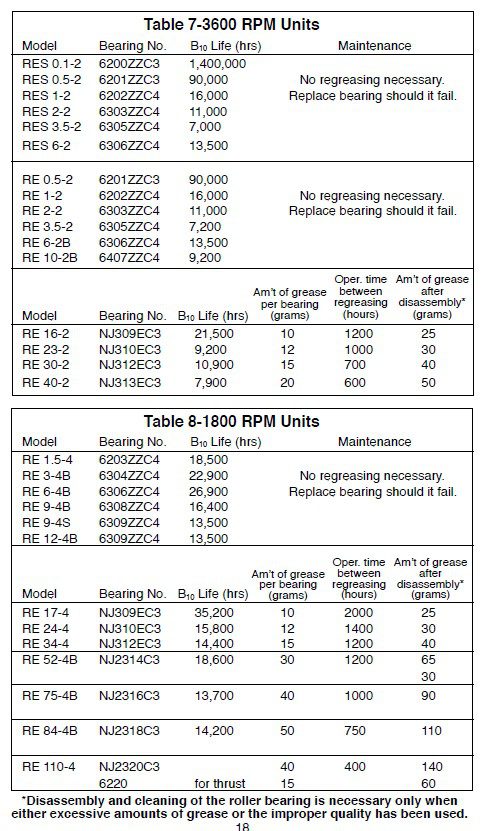
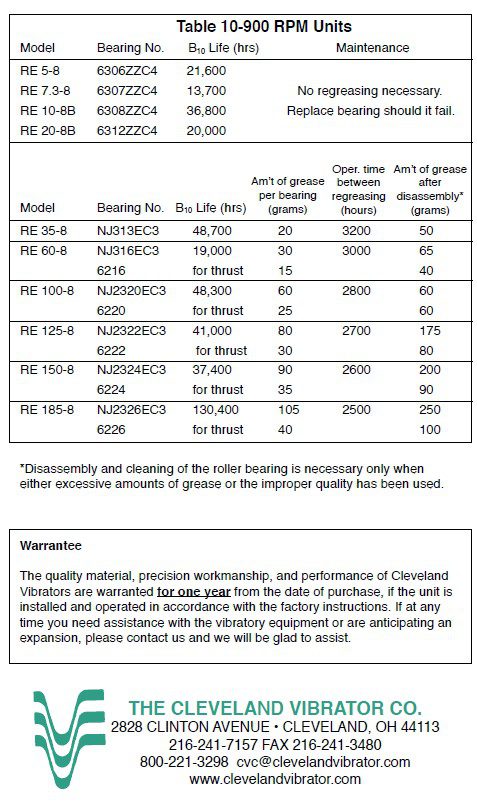
We went with 2.0 grams per pump, even with our measured weight being closer to 1.75 per pump. You can damage the bearing and cause premature failure of the unit, so it is essential to not over-grease. We concluded 2.0 grams per pump is best to prevent under-greasing as well. Refer to our RE 1200 RPM Rotary Electric Motor greasing chart illustrated below: “RE 80-6 Vibrator.” The chart indicates that adding 50 grams of grease per bearing after 1600 hrs, at 2.0 grams per pump, would be 25 pumps of the grease gun, and would add a plus or minus 10 to 20% facture to this.
You should note that you can also do half-life greasing which in the RE 80-6 case would be 12 or 13 pumps per bearing. We have included greasing charts for all RPMs below. Note that some models are permanently lubricated at the factory.
Need more information about the maintenance of your vibratory equipment? We are here to help! Click here to speak to our knowledgeable Sales & Services Team.
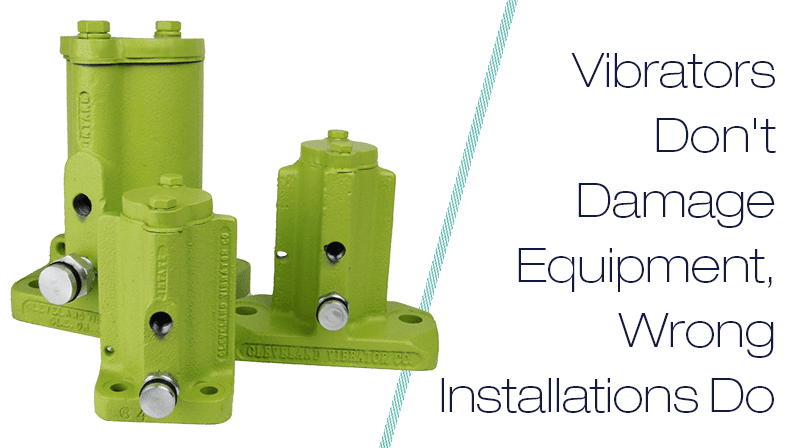
Recently, I took a whirlwind trip through the heartland. During this trip, I had the opportunity to visit plants and equipment makers installing and using vibrators. While in the field, I encountered damaged equipment, including cracked hopper walls that had to be re-welded.
Too often, the vibrator gets a bad rap in these situations. However, in reality, the damage is a function of incorrect sizing or installation of the vibrator. So to clear up any misconceptions, here are three easy recommendations to prevent future equipment damage:
Craig Macklin joined The Cleveland Vibrator Company in 2010. Although his prior experience is mired in the world of theoretical, intangible products and services such as software and consulting sales, the past 11 years have developed his passion for this industry and molded the vibration expert we know today. Now, as President and CEO, Craig has a deep understanding of the value and importance of industrial vibration to numerous industries and applications. He enjoys fine, locally roasted espresso, good food, and spending the day with his wife and two daughters. He has cried at multiple Browns and Indians games and likes to get outside and golf in his free time.
What’s his area of expertise, you ask? “Making sure the people on our team are better and smarter than I am.” – Craig Macklin
I’ve been told that my last blog regarding the importance of wall thickness when utilizing external industrial vibrators for bins or hoppers seems to have struck a chord. I plan to expand on that blog by providing some recommendations for sizing external vibrators since I merely referred to a vibrator with proper force previously – and you just may have been afraid to ask!
Essentially, we need to apply enough external force to the wall of the bin or hopper to assist gravity in getting material to flow. While I previously stressed properly flexing of the wall to get the material to flow, we still need to determine the correct amount of force to apply based on the configuration of the hopper as well as the bulk density and flowability of the material. Read More…
Jack Steinbuch retired in 2021 following a decades-long career with The Cleveland Vibrator Company, where he served as a Sales Engineer for more than 36 cumulative years. His background also includes extensive experience in the manufacturing industry as a Senior Application Engineer, and throughout his tenure with our team he contributed in both sales and managerial roles. Prior to his retirement, he held the position of General Sales Manager.
A graduate of The University of Toledo with a BSCE, Jack is highly regarded for his expertise in sizing vibratory screeners, feeders, and vibratory drives for tables and other equipment. Known for his dedication to customer service, he has always emphasized the importance of recommending the right solution for every application — even when that solution did not come from The Cleveland Vibrator Company.
Outside of work, Jack enjoys spending time with his family, especially his grandchildren. An avid sports fan and participant, he enjoys golf and spent many winters as a league bowler. With his retirement planned for the end of September 2021, Jack looked forward to spending future winters vacationing in Florida.
As further follow-on to my previous post, I wanted to look at a specific subset of Grain Entrapment and Engulfment cases. As I mentioned, I don’t think industrial vibrators and/or timed knockers are the silver bullet for preventing all cases. However, I do think they can be effective for Read More…
Craig Macklin joined The Cleveland Vibrator Company in 2010. Although his prior experience is mired in the world of theoretical, intangible products and services such as software and consulting sales, the past 11 years have developed his passion for this industry and molded the vibration expert we know today. Now, as President and CEO, Craig has a deep understanding of the value and importance of industrial vibration to numerous industries and applications. He enjoys fine, locally roasted espresso, good food, and spending the day with his wife and two daughters. He has cried at multiple Browns and Indians games and likes to get outside and golf in his free time.
What’s his area of expertise, you ask? “Making sure the people on our team are better and smarter than I am.” – Craig Macklin
Due in a large part to the efforts of NPR, I recently became more aware and educated on a tragic and horrifying issue in the Feed and Grain industry: Grain Entrapment and Engulfment. Basically, this is the incidence of being buried and/or drowned in bulk grain. I shudder to even think about the experience.
Reading through NPR’s listing of incidents, I noticed a couple of things that had me thinking more about why this is happening and whether Cleveland Vibrator Company might play a part in future prevention. First, the incidents reported seem to be more frequent in the past few years. Second, there is some recurrence of incidents stemming from people climbing into bins, hoppers and silos that have stuck material in order to “unstick” it.
Certainly, the second item connected with me as we are a manufacturer of material flow aids, like industrial vibrators and knockers, that are used to prevent or correct material sticking, clogging, rat-holing and bridging. I wanted to learn more about what we could do. So, I called Read More…
Craig Macklin joined The Cleveland Vibrator Company in 2010. Although his prior experience is mired in the world of theoretical, intangible products and services such as software and consulting sales, the past 11 years have developed his passion for this industry and molded the vibration expert we know today. Now, as President and CEO, Craig has a deep understanding of the value and importance of industrial vibration to numerous industries and applications. He enjoys fine, locally roasted espresso, good food, and spending the day with his wife and two daughters. He has cried at multiple Browns and Indians games and likes to get outside and golf in his free time.
What’s his area of expertise, you ask? “Making sure the people on our team are better and smarter than I am.” – Craig Macklin
If you didn’t read Part 1: $100,000, you should immediately. It is life changing.
All set? Great. Welcome back. Incredible wasn’t it? If you didn’t really go read it, you might struggle with your conscience later, but you should still be able to follow the rest of this post fine.
Similar to the value of vibration in diamond mining catching my attention, the value of industrial vibration to feeding cows also caught my attention. Why?? Read More…
Craig Macklin joined The Cleveland Vibrator Company in 2010. Although his prior experience is mired in the world of theoretical, intangible products and services such as software and consulting sales, the past 11 years have developed his passion for this industry and molded the vibration expert we know today. Now, as President and CEO, Craig has a deep understanding of the value and importance of industrial vibration to numerous industries and applications. He enjoys fine, locally roasted espresso, good food, and spending the day with his wife and two daughters. He has cried at multiple Browns and Indians games and likes to get outside and golf in his free time.
What’s his area of expertise, you ask? “Making sure the people on our team are better and smarter than I am.” – Craig Macklin
From my perspective industrial applications for vibrators and vibratory equipment tend to fall into three broad categories. The first and largest of these groups is the “standard” application, whether for individual vibrators or for equipment. Similar problems have been seen before and solved with “off the shelf products”. In the world of individual vibrators, these standard applications tend to involve flow aids for stationary hoppers and bins where both pneumatic and electric vibrators have proven over the years to be viable solutions. Appropriate vibrators can be selected or recommended based on the size of the hopper, weight of the material, hopper design (to include shape and wall thickness) and nature of the material.
My second broad group is somewhat smaller than the “standard” group and involves more customer interaction and discussion to arrive upon a suitable solution. These types of challenges would fall into what I’d call the “cooperative” group. Read More… Share this blog post: