

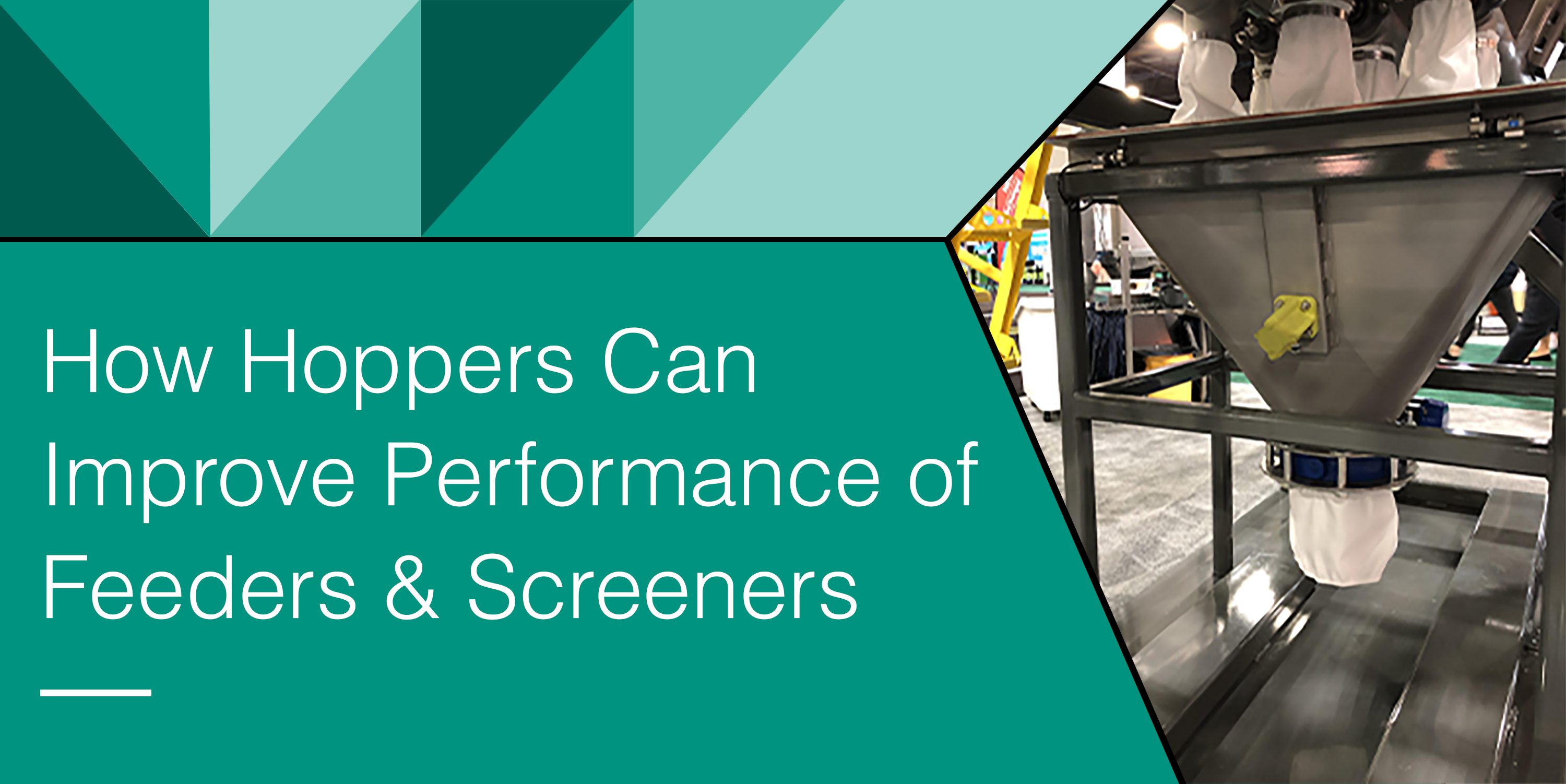
Hoppers can aid in the performance of material handling equipment, plus provide health and safety benefits for your workforce. To begin, we will review the advantages hoppers can provide to improve the performance of feeders and screeners for bulk loading applications.
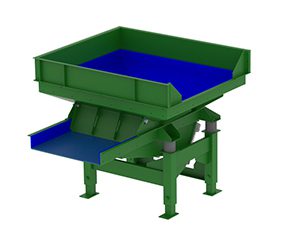
Okay, so what is a hopper?
Hoppers can be stationary with steeply sloping walls to allow free-flowing material to discharge onto the feed tray. Due to their steep walls, these hoppers can have a high dump height, depending on the volume. For lower dump heights and/or poor flowing materials, a vibrating hopper is a great solution. The hopper is attached to the vibrating body and the vibrators are then upsized to compensate for the increase in vibrating weight. The material is fed from the hopper onto the equipment.
How can a hopper improve the performance of your feeder?

Let us start with vibrating feeders. There are several applications where the material is fed manually or by a bulk loading dumper. This can lead to overloading the tray at the feed end and spillage. Utilizing a hopper provides the operator with a much larger target, so there is a much lower chance for spillage. We also provide a gate at the discharge end of the hopper to control material flow onto the feed end of the tray.
Additionally, the hopper takes the brunt of the dump, which saves wear & tear on the feeder tray. Further, we can provide lining for the hopper and feeder tray with abrasion-resistant material. This lining can provide the added benefit of noise reduction.
Before we continue, if you would like to learn more about how vibratory feeders work, our vibration experts provided this great tutorial!
Comparatively, how can a hopper improve the performance of your screener?
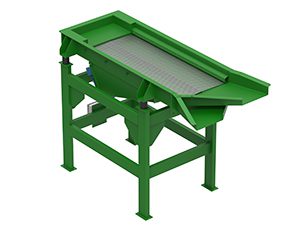
While the above also applies to vibratory screeners, they can result in even more benefits than feeders when provided with a hopper for bulk loading. Material flow to a screener is critical to its efficiency. Any excessive material flow depth or irregular feeding can negatively impact the performance of a screener. A hopper can provide an even, steady material flow to the screen deck.
How can a hopper provide health benefits to your employees?
The health benefits of a hopper include reduced wear and tear to operators that manually dump material onto feeders or screeners. Consequently, this type of labor can cause serious health issues to backs, shoulders, arms, and even lungs & eyes if the material is dusty.
Additionally, using a hopper puts the operator further from the vibratory equipment, reducing their noise exposure. Safety is improved as the operator is no longer exposed to the risks associated with manually feeding vibratory equipment.
You now have several good reasons, including improved performance and health and safety benefits, to consider utilizing a hopper to load your vibratory feeders or screeners. As always, we recommend that you review your application with a vibration expert. They will be able to guide you to the hopper design that best fits your specific application.

Jack Steinbuch retired in 2021 following a decades-long career with The Cleveland Vibrator Company, where he served as a Sales Engineer for more than 36 cumulative years. His background also includes extensive experience in the manufacturing industry as a Senior Application Engineer, and throughout his tenure with our team he contributed in both sales and managerial roles. Prior to his retirement, he held the position of General Sales Manager.
A graduate of The University of Toledo with a BSCE, Jack is highly regarded for his expertise in sizing vibratory screeners, feeders, and vibratory drives for tables and other equipment. Known for his dedication to customer service, he has always emphasized the importance of recommending the right solution for every application — even when that solution did not come from The Cleveland Vibrator Company.
Outside of work, Jack enjoys spending time with his family, especially his grandchildren. An avid sports fan and participant, he enjoys golf and spent many winters as a league bowler. With his retirement planned for the end of September 2021, Jack looked forward to spending future winters vacationing in Florida.
Follow us:


Share this blog post:


