

Industrial Vibrator Beat

Jack Steinbuch

How Hoppers Can Improve Performance of Feeders & Screeners

By Jack Steinbuch

Hoppers can aid in the performance of material handling equipment, plus provide health and safety benefits for your workforce. To begin, we will review the advantages hoppers can provide to improve the performance of feeders and screeners for bulk loading applications.
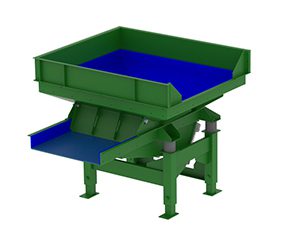
RFM electromechanical hopper feeder Side loading
Hopper

Okay, so what is a hopper?

Hoppers can be stationary with steeply sloping walls to allow free-flowing material to discharge onto the feed tray. Due to their steep walls, these hoppers can have a high dump height, depending on the volume. For lower dump heights and/or poor flowing materials, a vibrating hopper is a great solution. The hopper is attached to the vibrating body and the vibrators are then upsized to compensate for the increase in vibrating weight. The material is fed from the hopper onto the equipment.

Read More…

Share this blog post:

FacebooktwitterlinkedinmailFacebooktwitterlinkedinmail
Jack Steinbuch

Reduce the Noise Level on Your Vibratory Equipment

By Jack Steinbuch

OSHA specifies that a hearing conservation program should be in place when “noise exposure is at or above 85 decibels averaged over 8 working hours, or an 8-hour time-weighted average (TWA)”. This can be an issue for some vibratory equipment. However, we have selections available that will reduce noise levels which can result in many positives for your facility (OSHA).

For example, did you know investing in noise-reducing vibration can lead to an increase in productivity and overall safety? High noise levels can lead to short- and long-term physical damage including ringing ears, temporary changes in hearing, and long-term hearing damage or loss. But, less commonly known, it can also put a strain on your pocket by reducing productivity, contributing to poor communication and concentration, and can even contribute to workplace accidents by limiting your employee’s ability to understand speech (OSHA).

Since there is a wide variety of vibratory equipment, for this blog, we will focus on “brute force” vibratory equipment.  The vibrating body is directly installed on the equipment and is driven by a vibrator or dual motors, and the supporting structure is isolated from the vibrating body. Now let us look at potential ways to reduce their noise level:

Read More…
Share this blog post:
FacebooktwitterlinkedinmailFacebooktwitterlinkedinmail
Avatar

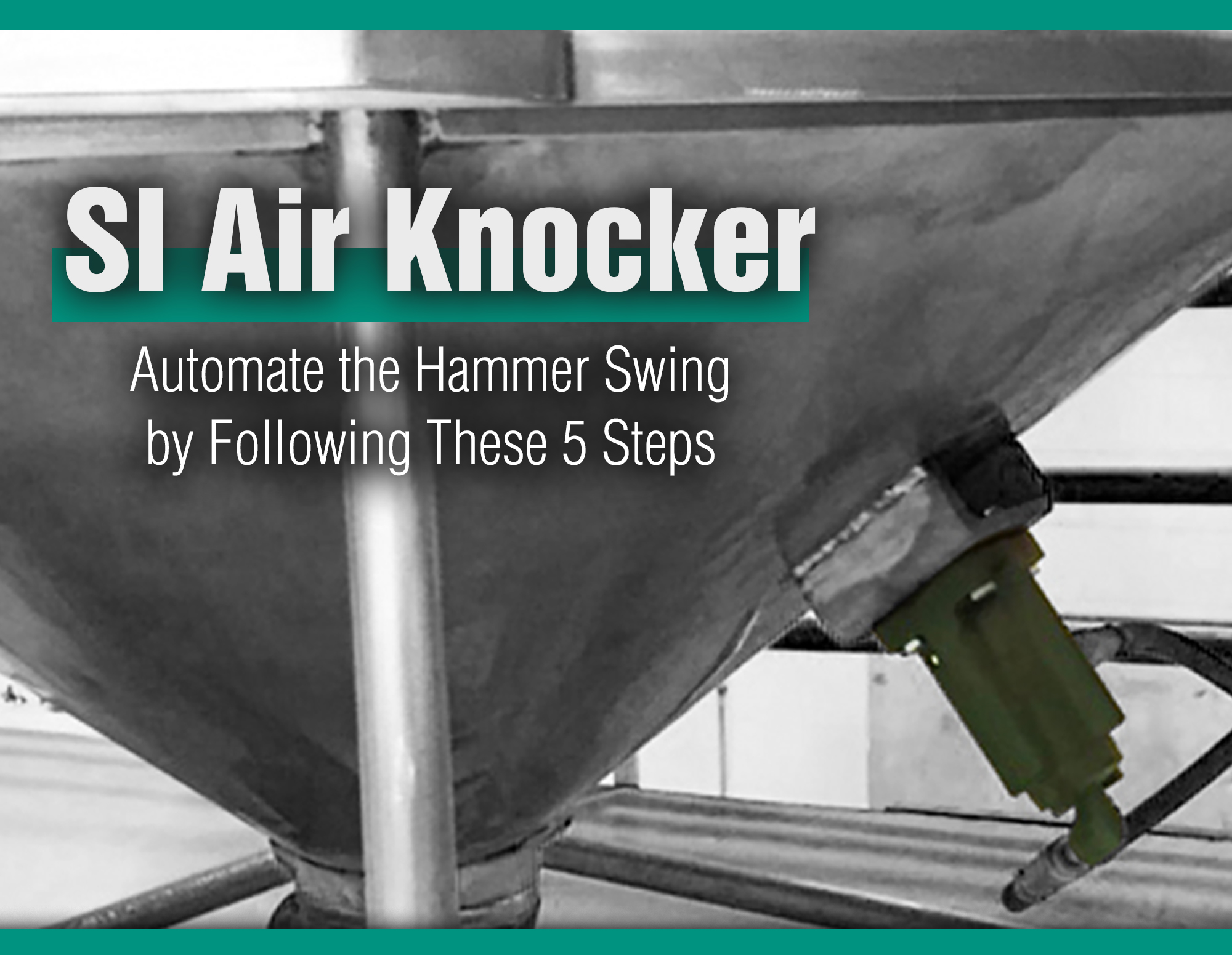
Automate the Hammer Swing by Following These 5 Steps

By Cleveland Vibrator Team

Our team is frequently asked about the proper installation of our Single Impact Air Knocker units. Since these units require two strokes of air for proper operation, the required components and installation process are slightly different than a more traditional pneumatic piston vibrator. Here, we will answer frequently asked questions and walk through the step-by-step installation process.

Step One

After properly sizing and selecting the units (which can easily be completed by utilizing our Vibrator Selection Guide!), it is time to install. First order of business, what are the components required for proper operation? There are a few items needed:

  1. The Single Impact Air Knocker (Complete with the Exhaust Port Protector and Grade 5 mounting hardware, provided with each unit)
  2. The Mounting Channel
  3. Hoses
  4. Valve
  5. Filter/Regulator/Lubricator
  6. Safety Cable
  7. Timer Box (Optional)

Read More…
Share this blog post:
FacebooktwitterlinkedinmailFacebooktwitterlinkedinmail
Avatar

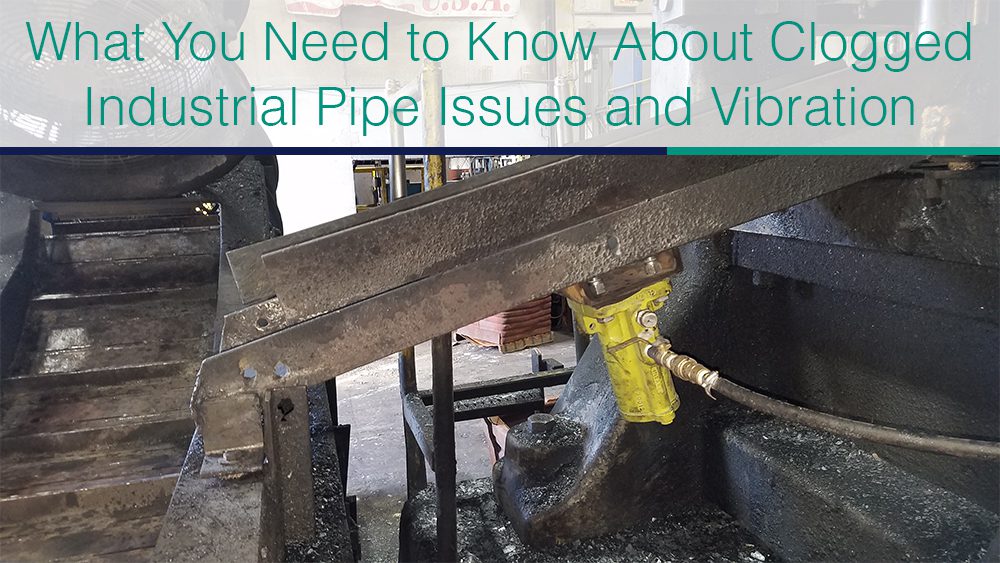
What You Need to Know About Clogged Industrial Pipe Issues and Vibration

By Cleveland Vibrator Team

Material flow issues are the worst. Not only are they a headache to deal with during production for the team out on the floor, but they may be costing you valuable time and money in the long run. The usual suspects for material flow hang-ups typically occur in bulk supply hoppers or industrial bins. But, what about those industrial pipes and chutes transferring materials throughout various stages of production?

Industrial vibration is not just for those usual suspects; it can be just as successful when applied to those transfer chutes and pipes! Not only does it get the job done, but it is economical and ultimately saves the integrity of your equipment and your team’s shoulders and backs.

Read More…
Share this blog post:
FacebooktwitterlinkedinmailFacebooktwitterlinkedinmail
Mike Stratis

How Vibration Helps Improve Dust Collection Systems

By Mike Stratis

When dealing with dust collection systems, it is critical to regularly clean the collected dust out of the equipment. One of the methods to remove the accumulated dust is with the help of vibration. Where the vibration is applied, though, depends on the collection system installed. Standard installations that we see are:

  • Electrostatic Precipitators (ESP)
  • Baghouses
  • Cyclones

Electrostatic Precipitators

First, we’ll discuss electrostatic precipitators. These are large systems that are frequently found at facilities, such as:

  • Pulp and paper or steel mills
  • Refineries
  • Concrete plants
  • Coal-fired power plants, just to name a few

The systems have a series of wires and plates that act as filters that rely on an electrostatic charge to pull dust particles from the air passing through the collection system. Keeping these wires and plates clean is imperative to the process because it helps increase the efficiency of the dust collection system.

This is where a Rapper comes into play.

The Cleveland Vibrator 3″ PMA Rapper is an air-powered piston vibrator that is installed on a mounting plate connected to a shaft to shake the wires and plates. This shaking process breaks the friction of the particulates clinging to the collection media. The dust then drops down to the collection hopper underneath. Once the material is in the collection hopper, an externally mounted piston vibrator or air knocker will remove the dust from the inside sloped walls of the hopper and to the discharge.

Read More…
Share this blog post:
FacebooktwitterlinkedinmailFacebooktwitterlinkedinmail
Jack Steinbuch

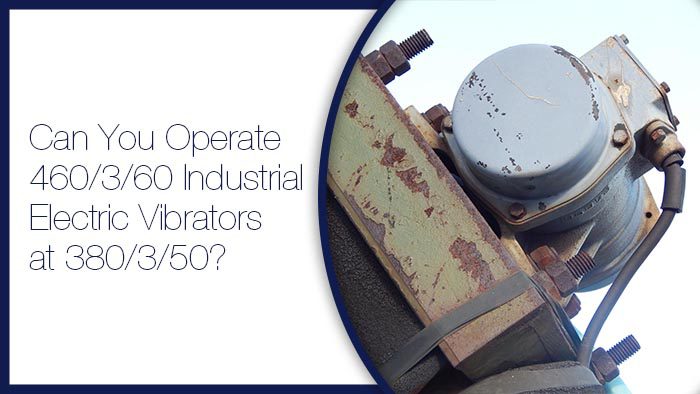
Can You Operate 460/3/60 Industrial Electric Vibrators at 380/3/50?

By Jack Steinbuch
Rotary electric motors, Industrial Vibration, Industrial Vibrators, The Cleveland Vibrator Company, Uras Techno, Vibratory Motor

I’ve noticed increased requests for operating stock U.S. rotary electric (motor) vibrators that are wound for 460/3/60 power overseas, where the power is often 380/3/50.  The good news is, there are two options available to operate a rotary electric vibrator with this power rating.

First is the realization that you can operate a 460/3/60 vibrator using 380/3/50 power. It works due to de-rating the higher voltage 60 Hz motor since 50 Hz power rotates the eccentric weights at a lower RPM (rotations per minute) by a factor of 50/60.  For example, an 1800 RPM vibrator would run at 50/60 x 1800 = 1500 RPM.

We can also apply this logic to voltage. So, a 460-volt motor would be de-rated to 383 volts by multiplying the 60Hz voltage by the same factor of 50/60.  Therefore, due to 50Hz input, a 60Hz vibrator will accept 380 volts ± 10% without jeopardizing the motor.

Note: Due to the eccentric weights rotating at a lower RPM, the force output will experience roughly a 30% decrease.

The exact amount of reduction is the square of the factor provided above for determining the lower RPM of the vibrator due to 50Hz.

Read More…
Share this blog post:
FacebooktwitterlinkedinmailFacebooktwitterlinkedinmail
Craig Macklin

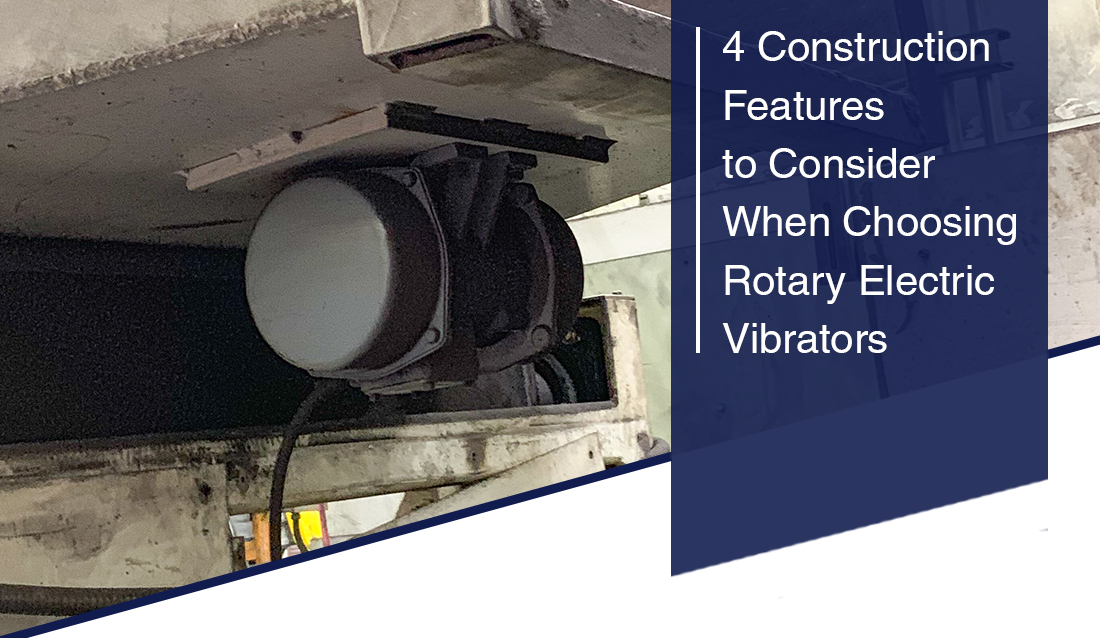
4 Construction Features to Consider When Choosing Rotary Electric Vibrators for Vibratory Equipment or Material Flow Applications

By Craig Macklin

Have you ever had someone try to push you over from your side?  I recall skiing with my big brother once when we were kids.  We had gotten off the chair lift and were stopped at the top of a run, getting ready to head down.  I was standing with skis closely together in parallel, hands off my poles as I adjusted my goggles. Big brother gave me a push on my shoulder from the side, perpendicular to the direction of my stance and skis.  I tipped right over.  There was nothing I could do about it.  It was hilarious… at least it was to him and everyone watching me flail about wildly on my way down.  Had I positioned my skis and stance wider and center of gravity lower, I could have avoided this embarrassing failure.

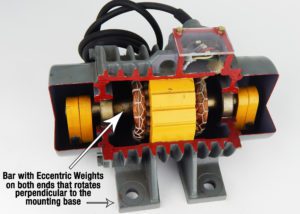
rotary electric vibrator, eccentric weights

Figure 1. Rotary Electric Vibrator Shaft

Such is as it is with Rotary Electric Vibratory Motors.  Imagine for a moment that you have a long bar going right through your solar plexus and out of the middle of your back.  Now that you are over that painful thought, imagine that at each end of the bar, there is a weight dangling from a rope and swinging around that bar.  Those weights are pushing you in every direction perpendicular to your feet and stance. You are now a Rotary Electric Vibrator! Can’t quite get the mental picture? Check out the photo to the right to see what I am talking about. Read More…


Share this blog post:

FacebooktwitterlinkedinmailFacebooktwitterlinkedinmail
Avatar

How to Choose the Best Truck Trailer Vibrators Based on the Material You’re Hauling

By CVC Team

Are you hauling a sticky material, such as DDG or soybean meal, in a hopper bottom trailer? Maybe carrying gravel or asphalt in a dump trailer? What about fertilizer in a v-body spreader?

The reason we ask this information when working with clients is that the material characteristics play a major role in determining the best type of vibrator to help quickly and safely unload the trailer. There is a big difference between unloading sticky DDG’s from a hopper bottom trailer compared to cleaning out the hopper bottom that was carrying whole potatoes or other free-flowing materials like corn and wheat. Read More…
Share this blog post:
FacebooktwitterlinkedinmailFacebooktwitterlinkedinmail
Mike Stratis

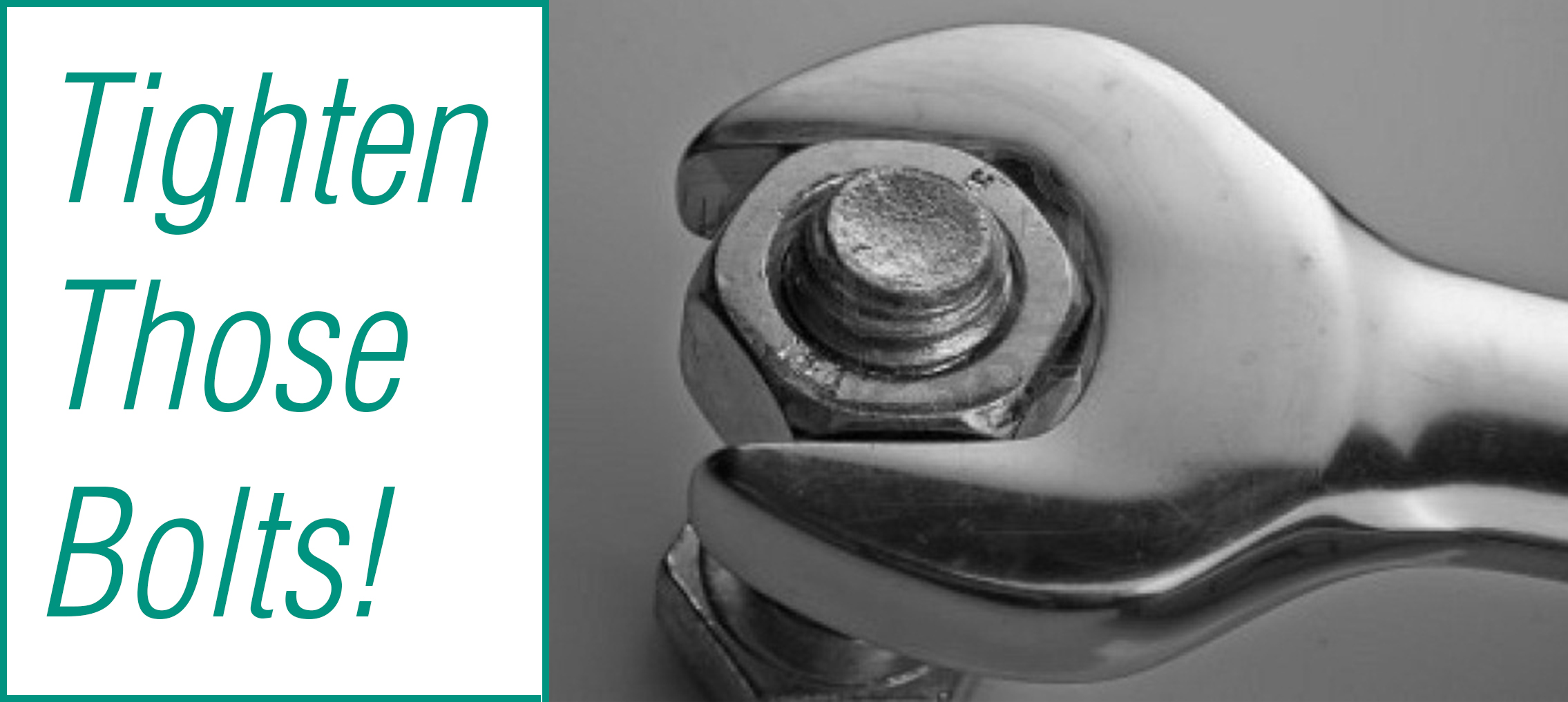
Tighten Those Bolts!

By Mike Stratis

If you happened to take the time to read Craig Macklin’s blog, about the expectations for maintenance of the pneumatic vibrators, then you’ll have a good base of knowledge on how to keep those units running efficiently. This time, we’ll take a deeper dive into the importance of tightening the mounting bolts used for installing the vibrators themselves.

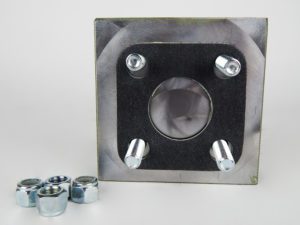
On the pneumatic piston vibrators, the proper bolt torque is critical. Because of the tight tolerance held between the outside diameter of the piston and the inside diameter of the bore of the casted body, the vibrator needs to air piston vibrator, nuts and bolts on pneumatic vibratorbe rigidly bolted in place to allow for correction operation so that only the piston is moving inside the vibrator. If the bolts are loose, even slightly, the vibrator body will “rock” back and forth on the mounting channel. Once this starts happening, failures or seized pistons can happen.

Why does this happen? The reason is, the piston will still try to move in a pure linear direction but if Read More…


Share this blog post:

FacebooktwitterlinkedinmailFacebooktwitterlinkedinmail
Mike Stratis

Properly Size an Industrial Vibrator on a Bulk Barge Hopper in 3 Easy Steps

By Mike Stratis

When it comes to unloading dry bulk bins, hoppers or vessels, we all know time is money. The more efficiently a job is done, the more time becomes available to take on new projects. More projects, equals… well, you get it.

One of the options available when it comes to material handling and unloading dry bulk barge hoppers or vessels is vibration. These externally mounted pneumatic or electric devices, when properly sized and installed, appropriately flex the bin or hopper wall to break free rat holing, bridging, caking or sticking material. With the assistance of the Cleveland Vibrator Selection Guide, the vibrator sizing process can be simplified and help increase successful installation. Read More…


Share this blog post:

FacebooktwitterlinkedinmailFacebooktwitterlinkedinmail
1 2 3 4 7  Scroll to top